
Time Signatures in Music: A Simple Guide for Beginners
If you are learning violin, keyboard, guitar, or another musical instrument, you will soon come across two numbers written at the beginning of a piece of sheet music.
These numbers are called the time signature.
At first, a time signature may look like a small mathematical fraction. But don’t worry — it is not a difficult calculation. It simply helps us understand how the beats are organized in music.
Once you understand time signatures, reading sheet music and keeping a steady rhythm becomes much easier.
In this guide from Alpha Violinist Music Academy, we will learn time signatures step by step using simple examples.
What You Will Learn
What is a time signature?
How to read a time signature
What the top and bottom numbers mean
Common time signatures such as 4/4 and 3/4
Simple and compound time
Duple, triple, and quadruple meter
Strong and weak beats
How time signatures can change
Frequently asked questions
What Is a Time Signature?
A time signature is normally written near the beginning of a piece of sheet music, after the clef and key signature.
It looks like two numbers placed one above the other.
For example:
4/4
The two numbers give us different information.
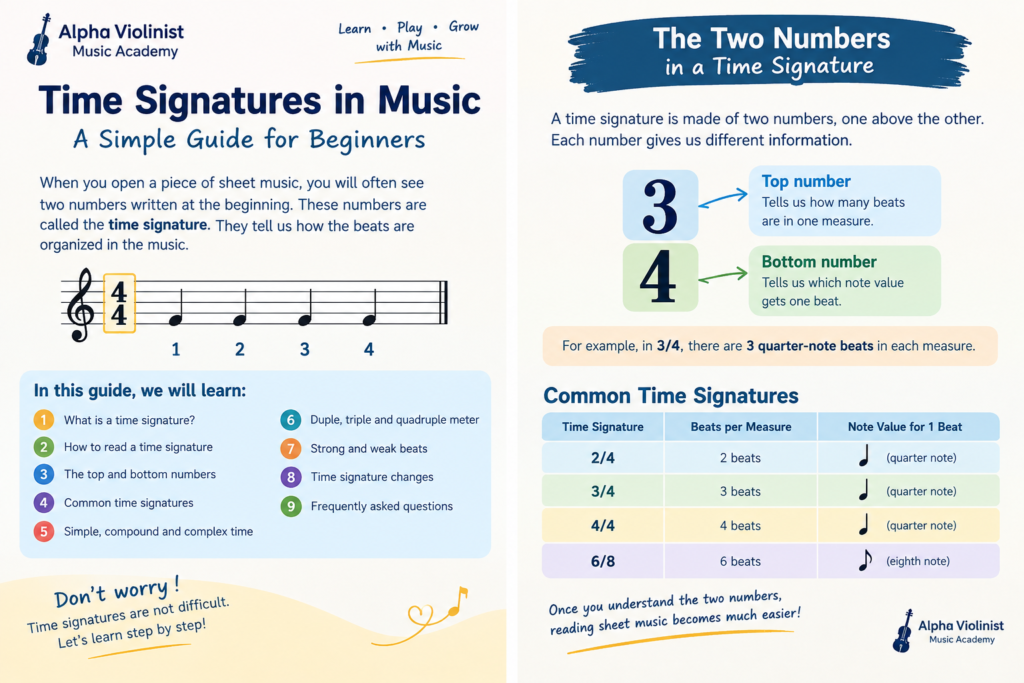
The top number tells us how many beats are in a measure.
The bottom number tells us which note value is used as one beat.
You may also hear the word meter when musicians talk about time signatures. In basic music theory, these terms are closely connected.
What Is a Measure or Bar?
Music is divided into small sections called measures or bars.
A vertical line called a bar line separates one measure from the next.
For example:
| 1 2 3 4 | 1 2 3 4 |
Each section between the bar lines is one measure.
The time signature tells us how the beats are organized inside each measure.
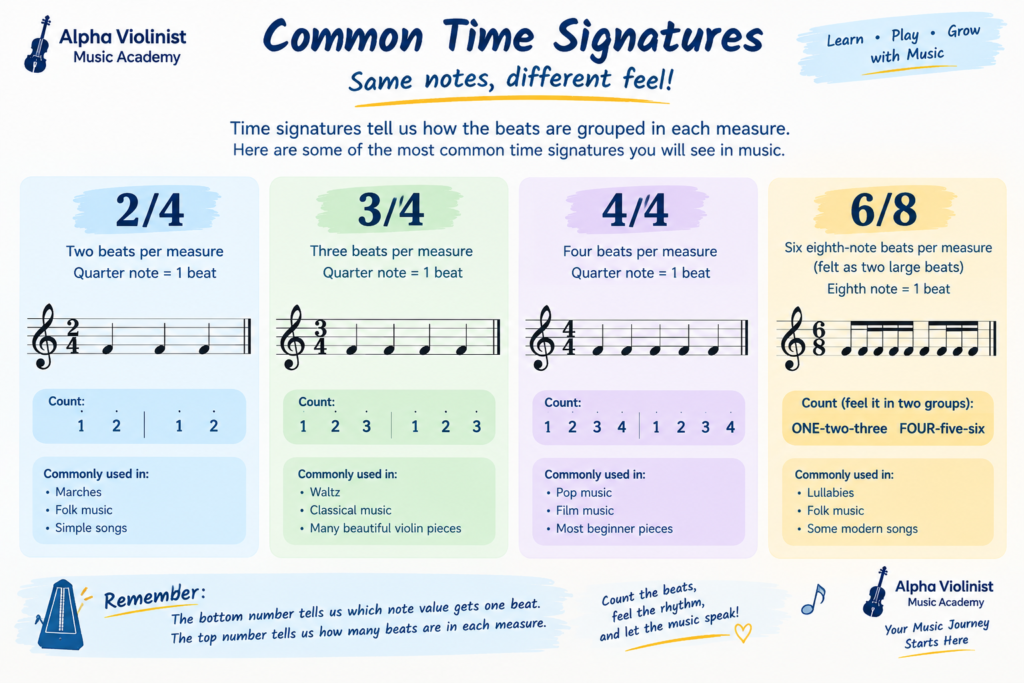
If a piece is in 4/4, each normal measure contains four quarter-note beats.
If a piece is in 3/4, each measure contains three quarter-note beats.
Understanding the Two Numbers
Let’s make this very simple.
The Top Number
The top number tells you:
“How many beats are there in one measure?”
For example:
2/4
There are 2 beats in each measure.
3/4
There are 3 beats in each measure.
4/4
There are 4 beats in each measure.
6/8
There are six eighth-note units in each measure, although musicians often feel them as two larger beats.
The Bottom Number
The bottom number tells you which type of note is being used as the basic beat.
Here are the most common examples:
4 = quarter note
8 = eighth note
2 = half note
1 = whole note
So:
4/4 means four quarter-note beats.
3/4 means three quarter-note beats.
2/4 means two quarter-note beats.
6/8 means six eighth-note units.
The relationship between note values does not change when the time signature changes.
For example:
Two eighth notes = one quarter note
Two quarter notes = one half note
Two half notes = one whole note
Understanding note values first will make time signatures much easier to learn.
How to Read a Time Signature
When you open a piece of sheet music, you will normally see something like:
Treble Clef → Key Signature → Time Signature
The time signature usually appears near the beginning of the music.
If the composer wants to change the meter later in the piece, a new time signature can appear at that point.
So when starting a new piece, don’t immediately begin playing the notes.
First look at:
The clef
The key signature
The time signature
The tempo
Any important musical instructions
This small habit can make sight-reading much easier.
4/4 Time — Common Time
One of the most important time signatures for beginners is 4/4.
In 4/4:
There are four quarter-note beats in each measure.
You can count:
1 – 2 – 3 – 4
Then the next measure begins:
1 – 2 – 3 – 4
For example:
| 1 2 3 4 | 1 2 3 4 |
A measure could contain:
Four quarter notes
Two half notes
One whole note
Or different combinations of notes and rests that add up to four beats
4/4 is extremely common in Western music.
You will find it in many songs, pop music, film music, beginner violin pieces, keyboard pieces, guitar music, and more.
Why Is 4/4 Sometimes Written as “C”?
Sometimes you may see a C instead of 4/4.
This symbol means Common Time.
C = 4/4
There is no difference in how you count or play them.
So if you see:
C
you can think:
4/4
and count:
1 – 2 – 3 – 4
3/4 Time
Another very common time signature is 3/4.
Here, each measure has three quarter-note beats.
You can count:
1 – 2 – 3 | 1 – 2 – 3
A measure could contain three quarter notes, or any combination of notes and rests that adds up to three beats.
3/4 is strongly associated with the waltz.
You may hear the feeling:
ONE – two – three
ONE – two – three
This gives the music a natural dancing movement.
2/4 Time
In 2/4, each measure contains two quarter-note beats.
You can count:
1 – 2 | 1 – 2 |
It is often used in marches and music with a clear two-beat feeling.
The first beat normally feels stronger:
ONE – two | ONE – two
The Two Main Ways Time Signatures Are Written
Time signatures can generally be seen in two forms.
Number-Based Time Signatures
These are the familiar signatures such as:
2/4
3/4
4/4
6/8
9/8
12/8
They are written using two numbers.
Symbolic Time Signatures
Some time signatures can be represented using symbols.
The most common examples are:
Common Time — C
This means 4/4.
Cut Time
Cut time looks similar to a C with a vertical line through it.
It represents 2/2 and is also known as alla breve.
What Is 2/2 or Cut Time?
In 2/2, there are two half-note beats in each measure.
You can think of it as:
ONE – two | ONE – two
A piece in 2/2 can sometimes look similar to 4/4 because you may see four quarter notes in a measure.
But the musical feeling is different.
In 2/2, the larger beat is the half note.
So if you see cut time, try to feel the music in two large beats per measure, rather than four small quarter-note beats.
Simple Time Signatures
Now let’s look at a slightly deeper music theory idea.
Time signatures can be classified as:
Simple
Compound
Complex
What Is Simple Time?
In simple time, each main beat can normally be divided into two equal parts.
Common simple time signatures include:
2/4
3/4
4/4
For example, one quarter-note beat can be divided into:
1 and 2 and
or visually:
quarter note = two eighth notes
This is called simple meter.
Compound Time Signatures
In compound time, each main beat is divided into three parts instead of two.
Common examples are:
6/8
9/8
12/8
This is an important difference.
Simple beat division
1 + 2
Compound beat division
1 + 2 + 3
The most important thing is not just the number of notes in the measure, but how the beats are grouped and felt.
Understanding 6/8
6/8 is one of the most common compound time signatures.
At first, you might think:
1 – 2 – 3 – 4 – 5 – 6
And technically there are six eighth-note units.
However, musicians often feel 6/8 as two larger beats, with each large beat containing three eighth notes.
So you can feel:
ONE-two-three FOUR-five-six
This is very different from simply feeling six equal beats.
Try tapping your hand on:
ONE
FOUR
while the smaller notes continue between them.
This is one of the best ways to understand compound meter.
9/8 Time
In 9/8, there are nine eighth-note units in a measure.
These are often grouped into three larger beats:
ONE-two-three FOUR-five-six SEVEN-eight-nine
So the basic feeling is:
3 + 3 + 3
This gives the music a flowing, three-part movement.
12/8 Time
In 12/8, the music is commonly felt as four large beats.
Each large beat contains three eighth notes.
You can feel:
ONE-two-three
TWO-two-three
THREE-two-three
FOUR-two-three
In other words:
3 + 3 + 3 + 3
12/8 is common in certain styles of songs, ballads, blues, and other musical situations where a strong flowing triplet feeling is required.
Complex or Odd Time Signatures
You may eventually come across time signatures such as:
5/8
7/8
8/8
10/8
11/8
These may look unusual when you first see them.
They are sometimes called odd meters or complex meters.
The important thing is to understand how the beats are grouped.
Understanding 5/8
5/8 can be grouped in different ways.
For example:
2 + 3
or
3 + 2
So you might feel:
ONE-two THREE-four-five
or:
ONE-two-three FOUR-five
The grouping depends on the music.
This is why simply counting from 1 to 5 may not always help.
You need to understand where the stronger beats occur.
Understanding 7/8
7/8 can also be grouped in different ways.
Common groupings include:
2 + 2 + 3
2 + 3 + 2
3 + 2 + 2
For example:
ONE-two THREE-four FIVE-six-seven
The exact grouping depends on the composition.
These meters may feel strange at first, but with practice they become much easier.
Duple, Triple, and Quadruple Meter
Another way to classify meter is by the number of main beats in a measure.
Duple Meter
Duple meter has two main beats.
Examples include:
2/4
2/2
Cut Time
6/8, when felt as two large beats
The feeling is generally:
ONE – two
Triple Meter
Triple meter has three main beats.
Examples include:
3/4
3/2
9/8, when felt as three large beats
The basic feeling is:
ONE – two – three
Quadruple Meter
Quadruple meter has four main beats.
Examples include:
4/4
4/2
12/8, when felt as four large beats
The basic feeling is:
ONE – two – THREE – four
Strong and Weak Beats
This is one of the most useful things to understand when learning rhythm.
Not every beat in a measure feels equally strong.
Some beats naturally receive more emphasis.
These are called strong beats, while the others are generally weaker.
Understanding this will help you play with better rhythm and musical expression.
Strong and Weak Beats in 4/4
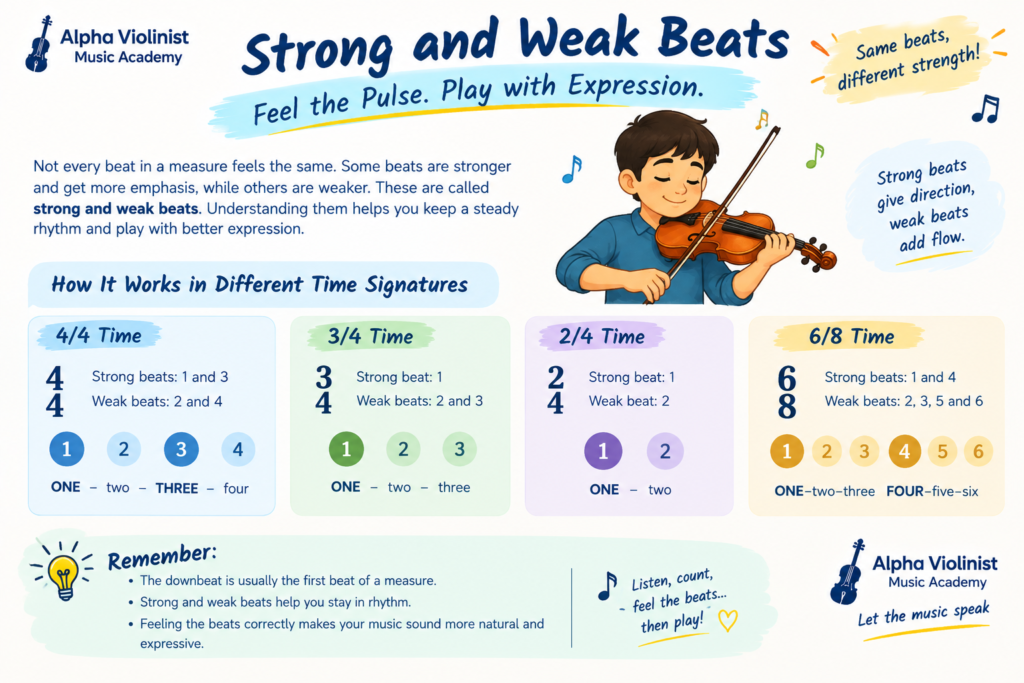
In 4/4, the first beat is normally the strongest.
The third beat may also receive some emphasis.
A basic pattern is:
ONE – two – THREE – four
Try tapping your hand while saying this.
You should feel the beginning of each measure clearly.
Strong and Weak Beats in 3/4
In 3/4, beat 1 is normally the strongest.
Think:
ONE – two – three
This is especially clear in a waltz.
The strong first beat helps dancers and musicians feel where each new group begins.
Strong and Weak Beats in 2/4
In 2/4, beat 1 is normally stronger:
ONE – two
This gives marches and other duple-meter music their characteristic forward movement.
Strong and Weak Beats in 6/8
In 6/8, the music is commonly felt as two large beats:
ONE-two-three FOUR-five-six
So the emphasis is often on:
1 and 4
You can also think of it as:
ONE-and-a TWO-and-a
This way of counting can make 6/8 much easier to feel.
What Is a Downbeat?
The downbeat is the first beat of a measure.
It is usually beat 1.
For example, in 4/4:
ONE – two – three – four
The ONE is the downbeat.
Conductors often make a downward movement with the hand to indicate the first beat, which is why the term “downbeat” is used.
Can a Song Change Time Signature?
Yes.
A piece of music can change from one time signature to another.
For example, a piece might begin in:
4/4
and later change to:
3/4
or:
6/8
When this happens, you will normally see a new time signature written at the point where the change occurs.
Time-signature changes are common in longer or more advanced compositions.
What Happens to the Tempo When the Time Signature Changes?
The tempo does not necessarily have to change when the time signature changes.
Sometimes the composer gives an instruction showing which note value remains at the same speed.
For example:
Eighth note = Eighth note
This tells the performer that the eighth-note pulse remains the same through the change.
This is particularly useful when moving between simple and compound meters.
Meter vs Rhythm — What Is the Difference?
These two terms are related, but they are not the same.
Meter
Meter is the organization of beats.
It tells us how beats are grouped into measures.
Rhythm
Rhythm is the pattern created by different note and rest durations.
A simple way to remember it is:
Meter = how the beats are organized
Rhythm = how the notes move through those beats
For a student learning sheet music, understanding both is important.
Can Two Different Time Signatures Sound Similar?
Yes.
Sometimes two different time signatures can create a similar overall feeling.
For example, you may find it difficult to distinguish certain meters simply by listening.
You might also confuse:
6/8 and 12/8
because both use compound beat divisions.
However, the way the music is grouped can be different.
This is why musicians learn to listen for the main pulse and grouping, rather than simply counting individual notes.
4/4 vs 12/8
This is a useful comparison for students.
Both can have four main beats.
But the way those beats are divided is different.
4/4
Each main beat can be divided into two eighth notes.
1-and 2-and 3-and 4-and
12/8
Each main beat can be divided into three eighth notes.
1-and-a 2-and-a 3-and-a 4-and-a
So although both can have four large beats, the internal rhythm is different.
Why Would a Composer Use 12/8 Instead of 4/4?
Imagine a piece where triplets appear almost continuously.
Writing every group as triplets in 4/4 can make the sheet music more complicated to read.
Using 12/8 can make the triplet-based feeling much clearer.
Instead of repeatedly writing triplet markings, the time signature itself tells the musician that the beats are naturally divided into groups of three.
What If I See a Time Signature Like 3+4/4?
Sometimes advanced music may show an unusual grouping such as:
3 + 4 / 4
This indicates that the seven beats are grouped as:
3 + 4
So instead of simply feeling seven equal beats, the performer knows how the composer wants the measure organized.
This type of notation is useful in more advanced and rhythmically complex music.
Why Is Understanding Time Signature Important for Violin Students?
For violin students, time signature is not just a theory topic.
It directly affects how you play.
It helps you understand:
When to start playing
How long each note should last
Where each measure begins
How to count rests
Where the strong beats are
How to use the bow naturally with the rhythm
How to play together with a teacher or other musicians
How to follow sheet music correctly
How to use a metronome effectively
For example, if you are playing a violin piece in 3/4 but accidentally feel it as 4/4, your rhythm will quickly become incorrect.
A Simple Practice Method
If you are a beginner, don’t try to learn every unusual time signature immediately.
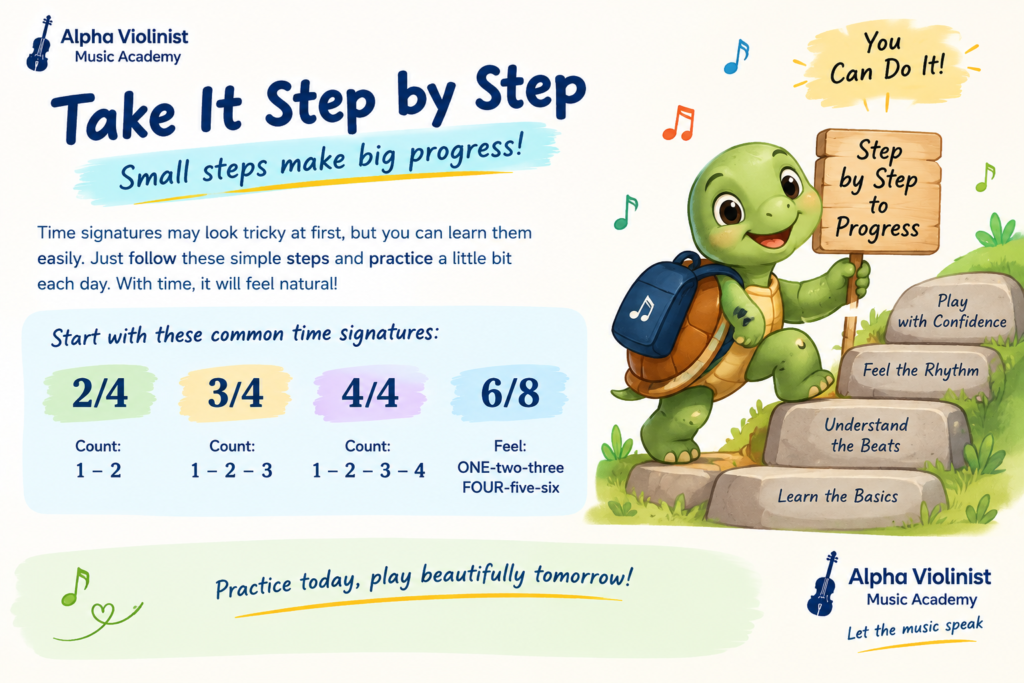
Start with these:
Step 1 — Learn 4/4
Count:
1 – 2 – 3 – 4
Step 2 — Learn 3/4
Count:
1 – 2 – 3
Step 3 — Learn 2/4
Count:
1 – 2
Step 4 — Learn 6/8
Feel:
ONE-two-three FOUR-five-six
Once these become comfortable, you can move on to 9/8, 12/8, 5/8, 7/8, and other meters.
Try This With Your Instrument
Take a simple piece of sheet music.
Before playing the first note:
Find the time signature.
Say the number of beats aloud.
Look at the first measure.
Check whether the notes add up correctly.
Clap or tap the rhythm.
Count with a metronome.
Then play the passage on your instrument.
For violin students, try tapping the rhythm first and then playing the same passage on the violin.
This helps separate rhythm problems from note-reading or fingering problems.
Frequently Asked Questions
Is a time signature the same as tempo?
No.
Time signature tells you how the beats are organized.
Tempo tells you how fast or slow the music is.
For example, a piece can be in 4/4 and be played slowly, moderately, or very quickly.
Can the time signature change in the middle of a song?
Yes.
A composer can change the time signature at any point in the music.
You will normally see the new time signature written where the change happens.
Is 4/4 the most common time signature?
4/4 is one of the most widely used time signatures, especially in Western music.
However, many other time signatures are also important.
What does C mean in music?
A C used as a time-signature symbol means Common Time, which is the same as 4/4.
What does the crossed C mean?
The crossed-C symbol represents Cut Time, which is 2/2.
It has two half-note beats per measure.
Is 6/8 the same as 3/4?
No.
They can sometimes feel similar because both can have a flowing three-part subdivision, but their beat organization is different.
In 3/4, there are normally three main quarter-note beats.
In 6/8, there are normally two large beats, each divided into three eighth notes.
A useful way to feel 6/8 is:
ONE-two-three FOUR-five-six
Why can’t I always identify the time signature just by listening?
Listening can tell you where the pulse is, but identifying the exact meter can sometimes be difficult.
For example, several meters can have similar note patterns.
With practice, you can improve this skill by:
Listening to a song.
Finding the main pulse.
Trying to group the beats.
Guessing the time signature.
Checking the sheet music afterward.
This is a very useful exercise for developing your musical ear.
Final Thoughts
Time signatures are one of the basic building blocks of music.
You don’t need to memorize every possible time signature when you are just starting.
Begin with:
2/4 → 3/4 → 4/4 → 6/8
Understand how the beats are grouped, learn to count them, and practise them with your instrument.
As your music-reading skills improve, you can gradually explore more advanced meters such as 5/8, 7/8, 9/8, and 12/8.
At Alpha Violinist Music Academy, we believe music theory should support your playing rather than make learning feel difficult. When you understand why the notes are organized in a particular way, reading and playing music becomes much more natural.
Whether you are learning violin, keyboard, guitar, veenai, or music theory, learning rhythm and time signatures will give you a stronger musical foundation.
Keep practising, keep counting, and let the music speak.
Learn More with Alpha Violinist Music Academy
Explore more beginner-friendly lessons on:
Reading sheet music
Note values and rests
Rhythm
Key signatures
Scales
Music theory
Violin learning
Keyboard learning
Guitar learning
Visit alphaviolinist.com to explore our music learning resources and courses.